Best Computer Internal SCSI Port Cards Under $50 (2026)
Products were ranked by a value score combining port count, controller type, included accessories (cables/brackets), PCIe lane requirements, and price under $50
The Verdict
- Best Overall: PCIe SATA Card 8 Port with Cables and Low Profile Bracket — Best for extensive bay expansion: eight SATA ports and included cables with a low-profile bracket for tight cases
- Best Value: PCIe SATA 3.0 6-Port Expansion Card (1x PCIe) ash — Best for straightforward six-drive upgrades: ASM1166-based six-port SATA III card for broad compatibility
This roundup covers internal PCIe-to-SATA controller cards suitable for expanding drive bays on desktop systems, focused on practical value under $50. Selections prioritize port count, controller chip, form factor, and real-world expandability to help match cards to common upgrade needs
Top Picks
-
1

Best Overall PCIe SATA Card 8 Port with Cables and Low Profile Bracket
Best for extensive bay expansion: eight SATA ports and included cables with a low-profile bracket for tight cases
PCIe SATA card adds 8 SATA 3.0 6 Gbps devices to a computer. Includes 8 SATA cables and a low profile bracket for slim PCs. Built with ASM1064+JMB575 for stability and hot-swap support
- 8-port SATA 3.0 expansion
- 8 included SATA cables
- low profile bracket for slim cases
-
2

Best Value PCIe SATA 3.0 6-Port Expansion Card (1x PCIe) ash
Best for straightforward six-drive upgrades: ASM1166-based six-port SATA III card for broad compatibility
PCIe to SATA 3.0 expansion card with 6 ports for AHCI boot and storage. Suitable for desktop PCs, workstations, Mac Pros, and NAS. Some users report mixed experiences with installation and boot-time stability
- 6-port SATA III expansion
- PCIe 1x compatible
- heat sink for durability
-
3
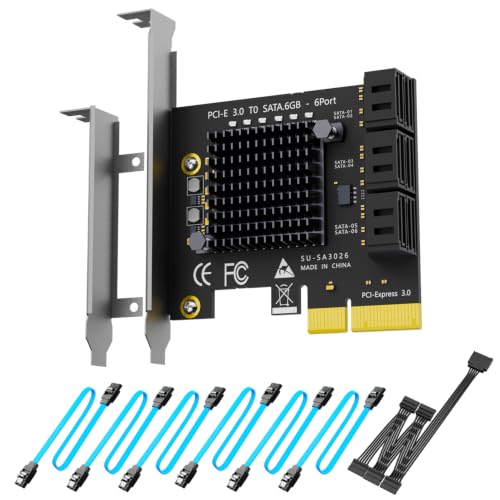
GLOTRENDS 6-Port PCIe X4 SATA Expansion Card
Best balanced pick: six-port PCIe x4 card that blends expandability and a compact installation footprint
6-port PCIe X4 SATA III expansion card for adding multiple drives. Suitable for software RAID in Windows, Mac OS, and Linux; includes power splitter cable. Customers note easy installation and additional SATA ports
- six downstream SATA ports
- PCIe 3.0 x2 upstream 16GT/s
- per-port bandwidth up to 277MB/s
-
4

PCIe 10-port SATA 3.0 Controller Card
Best for maximum port density: ten SATA ports when you need to attach many drives in a single PCIe slot
10-port SATA expansion card with PCIe x1 interface supports PCIe x1/x4/x8/x16. Includes 10 SATA cables; powered by ASM1166 and JMB575 chips. Customer insight: unspecified feedback
- 10-port SATA expansion
- PCIe x1 compatibility
- integrated SATA controller chips
-
5

RIITOP PCIe SATA Card 6 Ports
Best for reliable storage expansion: six-port PCIe x4 card focused on stable SATA III connectivity and easy installation
RIITOP PCIe to SATA expansion card adds 6 SATA 3.0 ports via PCIe x4/x8/x16. Plug and play with AMS1166 chipset for stable compatibility and up to 6Gbps per port. Customers note driver-free setup and out-of-the-box functionality, with occasional bootable support issues
- 6x SATA 3.0 ports
- PCIe x4 Gen3 transmission
- no-driver, plug-and-play