Best Recording Signal Direct Boxes Under $50 (2026)
We ranked units by value score using factors like DI type, I/O options, build features (ground lift, chassis), and relative price under $50
The Verdict
- Best Overall: Hosa DIB-443 Sidekick Passive DI Box — Best for simple instrument routing: compact passive design with instrument-to-XLR connectivity and durable metal housing
- Best Value: StudioMan DI Passive DI Box 1-Channel XLR/TRS — Best for top-rated value: passive one-channel DI with XLR/TRS options and ground-lift in a compact chassis
Top Picks
-
1

Best Overall Hosa DIB-443 Sidekick Passive DI Box
Best for simple instrument routing: compact passive design with instrument-to-XLR connectivity and durable metal housing
Passive DI box converting 1/4 in TS to XLRM for clean signal isolation. Noted for solid build, quiet operation, and easy use. Users value its impedance matching and sound quality
- quiet operation
- quality connectors
- impedance match capability
-
2

Donner Special-I Passive DI-Box for stage and studio
Best for hum reduction: passive DI with ground-lift and stage-focused features to cut noise in live and studio setups
Multi-purpose direct injection box with transformer isolation for instrument to mixer/amp. Delivers clean, ultra-flat response and hum reduction with ground lift option. Customers note solid build and noise-free signal
- transformer isolation for hum elimination
- balance/unbalance conversion to mic level
- low-noise direct box with ground lift
-
3

Behringer Ultra-Di DI100 Active DI-Box (sold in sets of 10)
Best for buffered sources: active DI that provides onboard electronics to drive long cable runs and varied inputs
Active DI box with switchable input attenuation and ground lift. Delivers clean sound and strong signals, with phantom power support from mixers. Mixed feedback on battery power usability
- switchable input attenuation
- ground lift
- phantom power compatibility
-
4

ART ZDirect Professional Passive Direct Box
Best for guitarists who want a tried-and-true passive solution with straightforward instrument matching and solid build
Passive DI box with flat frequency response and high signal handling. Users note solid build, good value, and clean line noise reduction in some setups
- flat wide frequency response
- passive interface
- neutral sound quality
-
5

Best Value StudioMan DI Passive DI Box 1-Channel XLR/TRS
Best for top-rated value: passive one-channel DI with XLR/TRS options and ground-lift in a compact chassis
Passive direct box converts high-impedance, unbalanced signals to a balanced mic-level output for mixer input. Ground lift reduces hum and ground loops; no power required. Includes parallel 1/4" TS jacks for simultaneous amp and mixer connections
- true signal integrity with ground lift
- uninterrupted signal monitoring via parallel jacks
- requires no external power
-
6

ART DualZDirect Dual Professional Passive Direct Box
Best for two-channel needs: dual passive DI that saves space while providing independent signal isolation for two instruments
Passive direct box with transformer design, converting 50k ohm inputs to 600 ohm balanced outputs. Includes switchable input attenuation and low pass filter. Customers note clean sound, solid build, and good value for money
- Fully passive transformer design
- Switchable attenuation and LPF
- 50k to 600 ohm balanced conversion
-
7
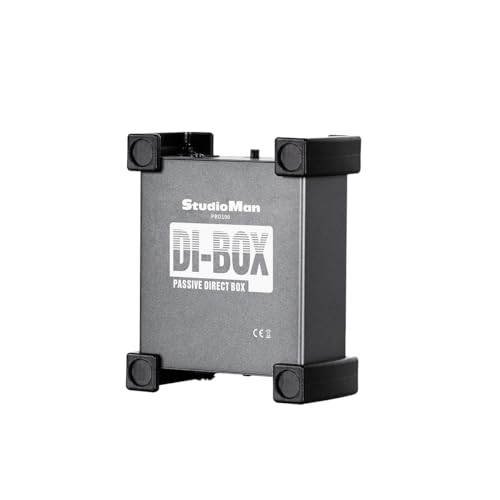
StudioMan PRO100 Passive DI Box: 1/4" to XLR, impedance matching
Best for impedance matching: passive DI optimized for 1/4" to XLR conversion and consistent instrument-to-mixer levels
StudioMan PRO100 converts unbalanced instrument signals to balanced XLR with noise reduction. Features impedance matching and ground-loop hum elimination for clear audio in live, studio, and rehearsal settings. Road-ready with anti-vibration pads
- impedance matching
- hum elimination
- durable, vibration-damping housing