Best Renewable Energy Controllers (2026 Guide)
We selected controllers by combining user rating averages with review volume, covering MPPT and PWM types, monitoring features, and durability for outdoor use
The Verdict
- Best Overall: Victron SmartSolar MPPT Solar Charge Controller (Bluetooth) 75V 10A — Best for compact MPPT setups: Bluetooth monitoring with 75V input support for flexible small-array configurations
- Best Value: Renogy Wanderer Li 30A PWM Solar Charge Controller — Best budget PWM for lithium: simple 30A PWM design with lithium battery compatibility for small off-grid installs
This guide surveys top-rated renewable energy controllers for garden and patio systems, focusing on charge controllers and Bluetooth-capable monitoring modules. Picks were chosen by aggregating high user ratings and substantial review volume to highlight reliable controllers across MPPT and PWM technologies
Top Picks
-
1

Best Overall Victron SmartSolar MPPT Solar Charge Controller (Bluetooth) 75V 10A
Best for compact MPPT setups: Bluetooth monitoring with 75V input support for flexible small-array configurations
SmartSolar MPPT charge controller with Bluetooth for efficient solar charging and synchronized operation. Bluetooth range and easy setup noted by users
- mppt for max power output
- bluetooth connectivity
- synchronized multi-controller operation
-
2

Victron Energy SmartSolar MPPT Solar Charge Controller (Bluetooth) 12/24V
Best for monitored 12/24V systems: MPPT efficiency plus Bluetooth for on-site and remote battery management
SmartSolar MPPT charge controller with Bluetooth for configuration and monitoring. Optimizes power output and battery longevity with synchronized charging across controllers. Customers report easy setup and reliable performance
- MPPT efficiency
- Bluetooth configurability
- synchronized multi-controller support
-
3

Best Value Renogy Wanderer Li 30A PWM Solar Charge Controller
Best budget PWM for lithium: simple 30A PWM design with lithium battery compatibility for small off-grid installs
Renogy Wanderer Li 30A PWM solar charge controller supports multiple battery types and real-time charging stages via LEDs. Customers note easy setup and value, with mixed reliability reports and some manual clarity concerns
- multi-battery compatibility
- intelligent PWM charging
- real-time LED indicators
-
4

Victron Energy BlueSolar MPPT Solar Charge Controller 75V 10A
MPPT entry: 75V MPPT controller that balances efficiency and straightforward battery charging
Victron Energy BlueSolar MPPT solar charge controller maintains battery health with fast MPPT tracking and smart charging. It’s praised for build quality, ease of installation, and value for money, though Bluetooth clarity varies
- fast MPPT tracking
- intelligent charge algorithms
- battery health maintenance
-
5

Victron Energy BlueSolar MPPT Solar Charge Controller 100V
Best for higher-voltage arrays: 100V MPPT input rating suits larger panel strings and robust battery management
MPPT solar charge controller that maintains battery health and maximizes energy harvest through fast tracking and smart algorithms. Customers note easy installation, solid build, and reliable charge quality
- efficient MPPT performance
- battery health emphasis
- intelligent charging algorithms
-
6

Renogy Bluetooth module RJ12 for charge controllers
Best monitoring add-on: Bluetooth RJ12 module to add wireless diagnostics to compatible charge controllers
Bluetooth module for Renogy charge controllers enabling wireless monitoring via a dedicated app. Provides BLE connectivity and low energy use. Customers report easy installation and straightforward app interface
- bluetooth 4.2 and BLE tech
- embedded exclusive Bluetooth chip
- IP54 protection grade
-
7

Renogy Voyager 20A PWM Waterproof Solar Charge Controller
Best for outdoor durability: IP67-rated PWM controller designed to resist water and weather in patio installs
Compact PWM solar charge controller with 4-stage charging and IP67 waterproof rating. Helps protect batteries and enables outdoor use; users note easy setup and mixed reliability
- 4-stage charging
- IP67 waterproof
- LCD display with status
-
8
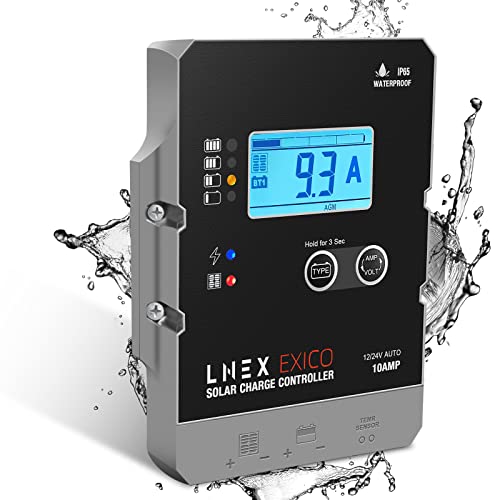
Solar charge controller waterproof 10A PWM regulator
Best waterproof compact option: 10A PWM regulator with LCD and rugged enclosure for small systems
Solar charge controller with LCD display, IP65 waterproof design for 12V/24V systems. Improves solar charging efficiency and supports LiFePO4, AGM, gel, flooded batteries. Customers note easy setup and reliable water resistance
- IP65 waterproof design
- 12V/24V PWM with LCD
- supports LiFePO4 and other chemistries
-
9

Morningstar SunSaver 6A PWM Solar Charge Controller
Best for very small systems: 6A PWM controller aimed at minimal 12V solar setups and simple battery charging
PWM solar charge controller for 12V battery banks with four-stage charging and temperature compensation. Includes a 3-state battery LED indicator and dead battery recovery; easy installation with factory presets
- four-stage charging
- temperature compensation
- easy preset installation
-
10

MPPT 12V 10A Solar Charge Controller with USB-C & USB-A
Best for modern device charging: MPPT 12V controller with USB-C and USB-A outputs for powering accessories
MPPT solar charge controller for 12V batteries (AGM, GEL, LiFePO4). Higher charging efficiency with maximum power tracking. LCD display aids monitoring; USB ports support devices like hubs
- MPPT for max solar power output
- USB-A and USB-C ports
- 12V battery compatibility