Best Copper Tubes (2026 Guide)
We selected options with strong aggregated ratings, substantial review volume, consistent material specs, and a range of common diameters and lengths to reflect real-world HVAC and refrigeration needs
The Verdict
- Best Overall: Copper Tubing 3/4 in OD x 5 ft seamless coil — Good for mid-length HVAC runs: 3/4" OD seamless coil that balances flexibility and run length
- Best Value: Copper Tube 1/2" OD x 7/16" ID 10 ft, soft seamless tubing — Great for one-person bending and routing: 1/2" OD soft seamless tube that’s easy to shape for repairs
This guide covers top-rated copper tubes for HVAC, refrigeration, and general plumbing, selected for common diameters, coil lengths, and build quality. Picks were chosen by aggregating product ratings, review volume, material spec (C12200/TP2), and useful size variety to represent common job requirements
Top Picks
-
1

Best Overall Copper Tubing 3/4 in OD x 5 ft seamless coil
Good for mid-length HVAC runs: 3/4" OD seamless coil that balances flexibility and run length
Annealed copper tubing, 3/4 in OD, 0.687 in ID, 5 ft length, seamless coil for HVAC and refrigeration. Customers note excellent quality and easy bending, with good corrosion resistance
- seamless deep-drawn tubing
- consistent copper quality
- suitable for HVAC/refrigeration
-
2

BELLA BAYS Copper Tubing 1/4" OD x 0.195" ID 25 ft
Best for compact refrigeration lines: 1/4" OD, longer 25 ft coil suited to tight routing and repeat jobs
Copper tubing, seamless coil, 1/4" OD x 0.195" ID, 25 ft. Suitable for HVAC, refrigeration, and DIY plumbing projects. Customers note excellent quality and ease of bending with good corrosion resistance
- seamless construction
- corrosion resistance
- bendable for easy installation
-
3

Copper Tubing 5/8 in OD x 0.562 in ID 10 ft Seamless Coil
Solid choice for 5/8" installations: seamless 10 ft coil providing manageable length with a robust diameter
Annealed UNS C12200 copper tubing, 5/8" OD x 0.562" ID, 10 ft coil, seamless and corrosion resistant. Customers note its high quality and easy bendability for DIY projects
- seamless design
- good corrosion resistance
- 10 ft coil length
-
4

Best Value Copper Tube 1/2" OD x 7/16" ID 10 ft, soft seamless tubing
Great for one-person bending and routing: 1/2" OD soft seamless tube that’s easy to shape for repairs
Soft copper tube with smooth seamless surface, manufactured to ASTM-B280; length slightly longer than 10 ft. Useful for refrigeration and DIY projects. Customers note good quality and clean, new appearance
- ASTM-B280 compliant
- soft seamless copper
- refrigeration and DIY compatibility
-
5

BELLA BAYS Copper Tubing 3/4 in. OD x 10 ft – seamless coil
Well-suited for longer HVAC runs needing 3/4" OD in a 10 ft seamless coil for fewer joints
Copper tubing, 3/4 in. OD, seamless coil, 10 ft length, suitable for HVAC, refrigeration, and DIY projects. Customers note high quality, good corrosion resistance, and easy bending with some mixed views on flatness
- seamless coil design
- 3/4 in. OD with 0.687 in ID
- 10 ft length, annealed UNS C12200
-
6

Copper Tubing 1/4 in OD x 0.187 in ID, 50 ft seamless coil
Handy for extended small-diameter work: 1/4" OD 50 ft coil that minimizes splices in long runs
Annealed UNS C12200 copper tubing, 1/4" OD x 0.187" ID, 50 ft seamless coil. Suitable for HVAC systems, refrigeration, and DIY projects; praised for quality and ease of bending
- seamless copper tubing
- dimensions 1/4" OD × 0.187" ID
- 50 ft coil length
-
7

BELLA BAYS Copper Tubing 3/8 in OD x 0.320 in ID, 25 ft
Balanced option for mid-length 3/8" circuits: 25 ft coil designed for common HVAC and refrigeration tasks
Copper refrigeration/AC tubing, seamless and coil-fed for HVAC systems and DIY projects. Customers note excellent quality, corrosion resistance, and easy bending
- annealed UNS C12200 copper
- specifications: 3/8 in OD, 0.320 in ID, 0.028 in wall
- coil length 25 ft
-
8
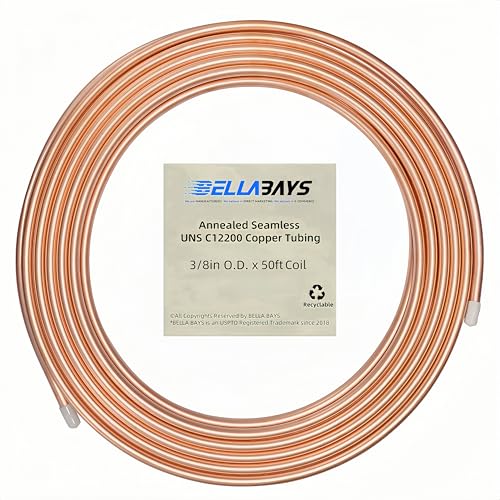
BELLA BAYS Copper Tubing 3/8" OD x 0.320" ID x 50 ft
Best for large projects needing fewer joints: 3/8" OD in a long 50 ft coil for extended coverage
Copper seamless tubing for HVAC, refrigeration, and DIY projects. 3/8" OD, 0.320" ID, 50 ft coil; durable and corrosion resistant with easy bending. Customers note quality and reliable performance for DIY plumbing
- seamless copper tubing
- 3/8" OD with 0.320" ID
- coil length 50 ft
-
9

Copper Tubing 1/4 in OD x 3/16 in ID 25 ft, 1/32 in wall, TP2 C12200 seamless refrigerant tubing
Good for TP2 applications: 1/4" OD with 1/32" wall in 25 ft, suited to standard refrigeration work requiring C12200
Copper refrigeration tubing, annealed TP2 grade, seamless surface with good conductivity. Upgraded wall thickness for higher pressure tolerance and durability; suitable for HVAC and DIY applications. Customer note hints solid solderability and ductility
- 1/4 in OD, 3/16 in ID, 1/32 in wall
- TP2 grade 99.9% copper
- annealed seamless tubing
-
10

Copper Tubing 3/4 in OD x 25 ft seamless coil
Appropriate for extended 3/4" installations: long 25 ft seamless coil to reduce fittings on long runs
Annealed uns c12200 copper tubing, 3/4" OD, 0.687" ID, 25 ft coil, seamless and easy to bend. Customer notes quality and functionality for DIY projects
- Seamless construction
- Accepts bending without kinking
- Corrosion resistant copper