Differential Equations (Books)
Top Products

Modern Methods in the Calculus of Variations: L^p Spaces
Irene Fonseca, Giovanni Leoni
Mid-Range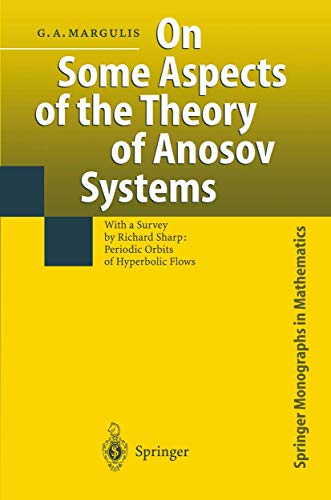
Periodic Orbits of Hyperbolic Flows (Survey)
Grigorii A. A. Margulis, Richard Sharp
Mid-Range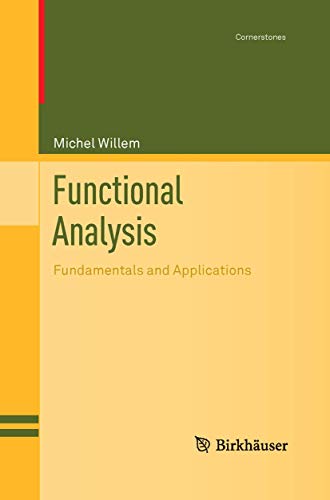
Functional Analysis: Fundamentals and Applications (Cornerstones)
Michel Willem
Mid-Range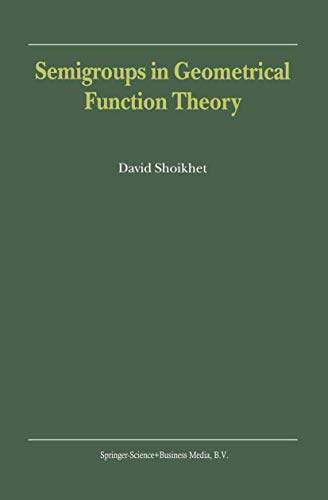
Semigroups in Geometrical Function Theory
D. Shoikhet
Mid-Range
Semilinear Evolution Equations and Their Applications
Toka Diagana
Mid-Range
The Fourier Integral and Certain of its Applications (Cambridge Math Library)
Norbert Wiener
Mid-Range
Mathematical Theory of Entropy (Encyclopedia of Mathematics and its Applications, Series 12)
Nathaniel F.G. Martin
Mid-Range
Controllability and Stabilization of Parabolic Equations (PNLDE Subseries in Control)
Viorel Barbu
Mid-Range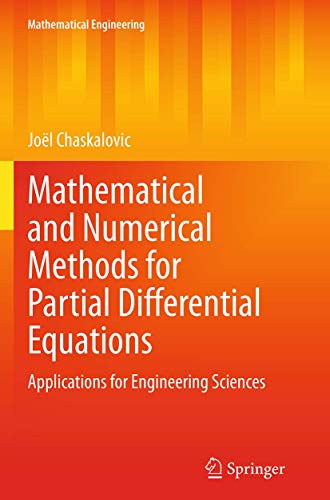
Mathematical and Numerical Methods for PDEs: Applications for Engineering Sciences (Mathematical Engineering)
Joel Chaskalovic
Mid-Range
An Invitation to Variational Methods in Differential Equations
David Costa
Mid-Range
Analysis of Finite Difference Schemes for Linear PDEs
Bosko S. S. Jovanovic, Endre Suli
Mid-Range
Numerical Methods for Bifurcation Problems and Large-Scale Dynamical Systems
Eusebius Doedel, Laurette S. Tuckerman
Mid-Range
Averaging Methods in Nonlinear Dynamical Systems (Applied Mathematical Sciences 59)
J. A. Sanders
Mid-Range
The Three-Body Problem and the Equations of Dynamics
Henri Poincare, Bruce D Popp
Mid-Range
Geometric Applications of Fourier Series and Spherical Harmonics
H. Groemer
Mid-Range
Optimality Conditions: Abnormal and Degenerate Problems
A.V. V. Arutyunov
Mid-Range
Mathematical Analysis
Mariano Giaquinta, Giuseppe Modica
Mid-Range
Nonlinear Ordinary Differential Equations: Analytical Approximation and Numerical Methods
Martin Hermann, Masoud Saravi
Mid-Range
Infinite Dimensional Optimization and Control Theory
Hector O. Fattorini
Premium
Truly Nonlinear Oscillations: Harmonic Balance, Parameter Expansions, Iteration, And Averaging Methods
Ronald E Mickens
Mid-Range
Numerical Bifurcation Analysis for Reaction-Diffusion Equations
Zhen Mei
Mid-Range
The Navier-Stokes Equations: An Elementary Functional Analytic Approach
Hermann Sohr
Mid-Range
Stability and Wave Motion in Porous Media (Applied Mathematical Sciences 165)
Brian Straughan
Mid-Range
Invariants of Quadratic Differential Forms
Joseph Edmund Wright
BudgetRoundups
- Best Differential Equations (Books) Under $50 (2026)
- Best Differential Equations (Books) for Graduate-Level Study (2026)
- Best Differential Equations (Books) for Research Reference (2026)
- Best Differential Equations (Books) Under $200 (2026)
- Best Differential Equations (Books) Under $100 (2026)
- Best Differential Equations (Books) (2026 Guide)
Frequently Asked Questions
How do I choose a differential equations book for home study or reference?
Pick a book that matches your background and goals: elementary/introductory texts for first-year undergraduates, applied/engineering-focused for practical modeling, and advanced/rigorous texts for theory. Check the table of contents for topics you need (ODEs, PDEs, numerical methods, applications) and sample chapters for writing style and worked examples
What should I consider about difficulty level and prerequisites?
Look for stated prerequisites—typically calculus, linear algebra, and sometimes real analysis. Introductory books assume single-variable calculus; intermediate texts expect multivariable calculus and matrix methods; advanced texts may require proofs and functional analysis background
Are there affordable options and what price range should I expect?
Differential equations books commonly range from budget paperbacks under $30 to advanced or hardcover academic texts over $100, with many quality options around the average price for the category. Consider used copies or older editions to reduce cost while retaining core content
How important are exercises, solutions, and worked examples?
Exercises and worked examples are crucial for mastering methods; books with problem sets and either full or selected solutions support self-study. For numerical methods and modeling, worked applications and computational examples are especially useful
Should I prefer books that include numerical methods and software examples?
If you plan to implement solutions or simulate models, choose a book that covers numerical methods (finite difference, finite element, Runge–Kutta) and includes code snippets or references to common tools; pure theory texts may omit computational guidance
What format and physical qualities should I consider for home use?
Consider format (paperback vs. hardcover) for durability, font size and layout for readability, and presence of index and bibliography for quick reference. If you annotate, a paper copy may be preferable; e-books are convenient for search and portability
How can I evaluate the book's approach to applications in physics, engineering, or other fields?
Inspect chapters or sample problems to see which application domains are emphasized and whether modeling, dimensional analysis, and real-world examples are included; applied texts typically integrate case studies and problem sets tied to specific fields