Angle Gauges
Angle gauges for measuring and transferring angles in woodworking, metalworking, and layout tasks, including digital and mechanical models. The category averages a 4.60 rating across about 10 indexed products, price points typically $33–$46, and features brands like XUNTOP and Calculated Industries
Top Products

Wixey Digital Angle Gauge with Backlight
Wixey
Budget
Magnetic digital angle locator with LCD backlit display
JOHNSON LEVEL & TOOL
Mid-Range
Klein Tools Angle Finder Digital Gauge with Magnetic Base
935DGGP
Budget
USB charging digital level box angle finder with laser
XUNTOP
Budget
AccuMASTER 2-in-1 digital level and angle finder
Calculated Industries
Mid-Range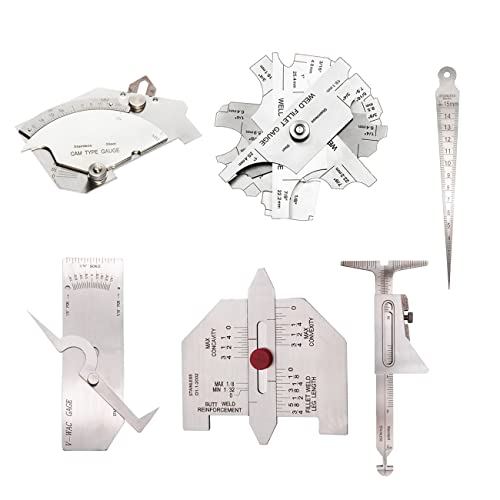
Weld Gauge Set with Cam, Fillet, Hi-Lo, Taper, Undercuts & Convexity Gauges
Necygoo
Mid-Range
Klein Tools 935DAA Digital Level & Angle Gauge
Klein Tools
Mid-Range
USB Digital Level Box with Laser & 4-Side Magnetic Gauge
XUNTOP
Budget
Huepar digital angle gauge protractor with dual axis level and magnet base
Huepar
Mid-Range
Huepar Pro Digital Angle Gauge with V-Groove Magnetic Base
Huepar Pro
BudgetRoundups
Frequently Asked Questions
What is an angle gauge and what tasks is it best suited for?
An angle gauge measures and transfers angles between surfaces and can be used for layout, tilting tools, setting bevels, duplicating angles, and checking slopes on carpentry, metalworking, and machining jobs
How do I choose the right type of angle gauge for my projects?
Choose based on accuracy needed, measurement range, and durability: digital gauges provide quick readouts and fine resolution, mechanical or bevel gauges are simple and rugged, and magnetic or large-scale models help when working with metal or large assemblies
What accuracy and resolution should I look for?
Look for resolution and accuracy specs that match your application; general woodworking often needs ±0.5° to ±1°, while metalworking or precision setups may require ±0.1° or better—digital models usually list resolution (e.g., 0.1°) and repeatability
Are digital angle gauges worth the extra cost compared with analog gauges?
Digital gauges offer faster, easier readings, often higher resolution, and features like zeroing and unit conversion, while analog gauges can be more durable and simpler; choose digital if convenience and finer measurements matter, analog for ruggedness and lower cost
How do I maintain and calibrate an angle gauge?
Keep the gauge clean and dry, avoid drops, store on a stable surface, periodically check against a known reference (like a precision square or flat surface) and follow manufacturer instructions for recalibration or battery replacement for digital units
What features are useful for shop use versus field use?
Shop use benefits from high-precision digital readouts, fine adjustment, and large bases; field use favors compactness, impact-resistant housings, magnetic bases, and battery longevity for digital models
How much should I expect to pay for a reliable angle gauge?
Prices vary by type and accuracy; basic mechanical or bevel gauges can be under $30, midrange digital gauges commonly fall between $30 and $100, and higher-precision professional models cost more