D Scanners
This category covers 3D scanners used in tools and industrial workflows—handheld, desktop, and LiDAR-based units for prototyping, inspection, and reverse engineering. Fifteen products average a 4.37 rating and span budget through premium prices (average about (price varies)); Revopoint is among the top brands
Top Products
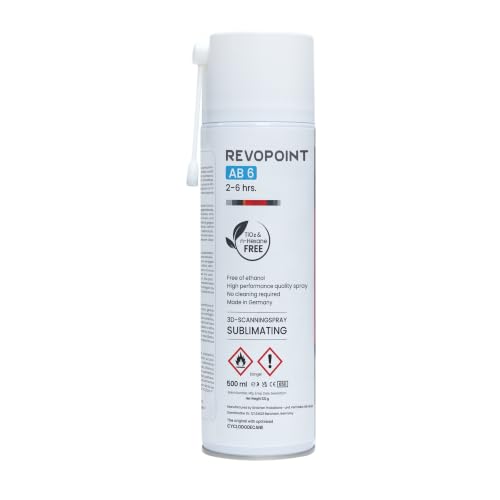
Revopoint 3D Scanning Spray for Surfaces 500ml AB6
Revopoint
Budget
Revopoint Auto Turntable for 3D Scanners
Revopoint
Mid-Range
Creality Ferret Pro 3D Scanner
Creality
Premium
Revopoint 28 Pieces 3D Marker Block Kit for 3D Scanning
Revopoint
Premium
RPLIDAR A1M8 360° 12m LIDAR sensor for robotics
Slamtec
Mid-Range
Revopoint MetroX 3D Scanner for 3D Printing
Revopoint
Premium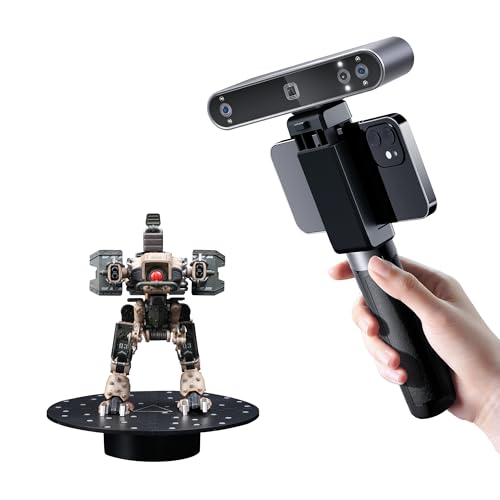
Revopoint POP3 Plus 3D Scanner
Revopoint
Premium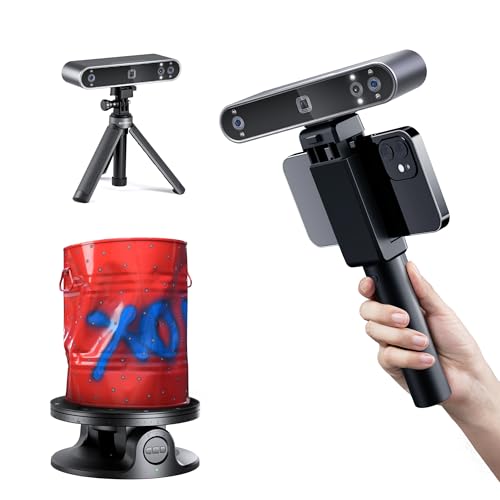
Revopoint POP3 Plus 3D Scanner for handheld 3D printing
Revopoint
Premium
Revopoint MetroX 3D Scanner for Metrology-Grade Precision
Revopoint
Premium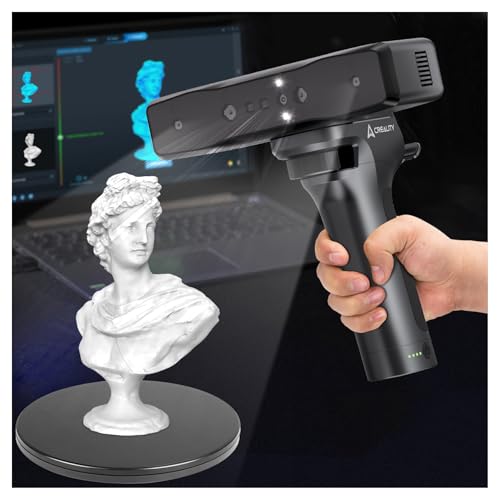
Creality Otter Lite Wireless 3D Scanner
Creality
Premium
Revopoint MIRACO 3D Scanner handheld wireless
Revopoint
Premium
Creality CR-Scan Raptor 3D Scanner for handheld 3D scanning
Creality
Premium
Creality CR-Scan Raptor 3D Scanner for 3D Printing
Creality
Premium
Revopoint MIRACO Plus 3D Scanner with photogrammetry
Revopoint
Premium
Creality Raptor X 3D Scanner with 60fps blue laser & NIR, wireless 6
Creality
PremiumRoundups
Frequently Asked Questions
What types of D scanners are available and how do I choose the right one for my application?
D scanners include handheld, tripod-mounted desktop, and industrial automated units; choose based on object size, required accuracy, and workflow—handheld for medium-to-large objects and flexibility, desktop for small detailed parts, and industrial units for high throughput and repeatability
What accuracy and resolution should I look for in a D scanner for prototyping or inspection?
For general prototyping, look for 0.1–0.5 mm accuracy and sub-millimeter resolution; for metrology or inspection tasks, target scanners that specify accuracy in tens of microns (e.g., 0.01–0.05 mm) and support point spacing or mesh resolution appropriate to the smallest feature you must capture
How do surface finish, color, and material affect scan quality?
Shiny, transparent, very dark, or highly reflective surfaces can cause noise and holes; matte, uniformly colored surfaces scan best—use temporary matte spray, a removable coating, or scan targets/markers to improve results when working with problematic materials
What should I consider about compatibility and software when buying a D scanner?
Check that the scanner supports common file formats (OBJ, STL, PLY), has drivers for your OS, and includes or works with software for alignment, cleaning, and exporting; also consider available plugins for CAD/inspection tools if you need reverse engineering or dimensional analysis
How do I maintain and calibrate a D scanner to keep performance consistent?
Follow the manufacturer's cleaning and storage recommendations, protect optics from dust and impacts, perform regular calibration using provided targets or procedures, and update firmware/software to ensure accurate measurements and compatibility
What price range should I expect for D scanners suitable for hobby, prosumer, and industrial use?
Entry-level or hobby-friendly D scanners typically start in the lower hundreds to around a thousand dollars for desktop units; prosumer handheld and higher-accuracy desktop models commonly range in the mid-hundreds to a few thousand, while industrial-grade scanners and complete automated systems are in the higher-thousand to tens-of-thousands range
What accessories or consumables are commonly needed with a D scanner?
Common accessories include turntables or tripods, calibration targets, mounting brackets, marker dots or stickers, matte spray for difficult surfaces, and spare power or connection cables; select accessories that match the scanner's workflow and object sizes you scan