Lab Power Supplies
Benchtop and portable DC laboratory power supplies for testing, prototyping, and electronics repair, including adjustable linear and switching units. The category covers 42 indexed products averaging a 4.49 rating, with mid-range prices around $35–$200 and brands such as Jesverty represented
Top Products

DC power supply with encoder knob and USB quick-charge
NANKADF
Mid-Range
DC Power Supply 30V 10A Adjustable Bench Regulated
Kungber
Mid-Range
DC bench power supply 0-32V 0-10A with encoder knobs
Jesverty
Mid-Range
DC Power Supply 0-60V 0-5A with USB-C quick-charge
Jesverty
Mid-Range
DC power supply 0-60V 0-5A with encoder knobs
Jesverty
Mid-Range
DC bench power supply 0-32V 0-10A with USB-C/USB-A charging
Jesverty
Mid-Range
NICE-POWER DC Power Supply 30V 10A, adjustable benchtop
NICE-POWER
Mid-Range
DC Power Supply 0-30V 0-10A Bench PSU with USB-C Quick Charge
Jesverty
Mid-Range
DC power supply 0-30V 0-10A with encoder knobs
WANPTEK POWER
Mid-Range
DC power supply 0-120V 0-3A with USB-C/USB-A fast charge
Jesverty
Mid-Range
DC Power Supply with encoder knob, USB-C, 30V 5A
NANKADF
Mid-Range
DC power supply 30V 10A with 4-digit LED display
LONGWEI
Mid-Range
DC Power Supply 60V 5A Adjustable Bench PSU
Kungber
Mid-Range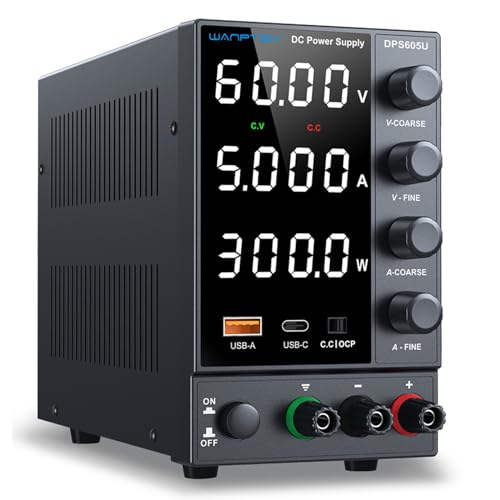
DC Bench Power Supply with Encoder, 0-60V 0-5A
WANPTEK POWER
Mid-Range
DC Variable Power Supply 0-30V 0-10A LW-K3010D
LONGWEI
Mid-Range
DC Power Supply 120V 3A Adjustable Switching Regulated Bench Power
Kungber
Mid-Range
DC bench power supply 0-120V 0-3A with encoder knob
Jesverty
Mid-Range
DC Bench Power Supply 0-30V 0-10A Adjustable 4-Digit Display
SKY TOPPOWER
Mid-Range
DC Power Supply 0-30V 0-10A with encoder knob
HANGELL
Mid-Range
DC power supply with voltage/current settings
NANKADF
Mid-Range
60V 5A DC Power Supply, adjustable bench unit
Naweisz
Mid-Range
DC Variable Power Supply 0-30V 0-10A with Encoder Knob
HANGELL
Mid-Range
DC Power Supply 0-30V 0-20A 600W with Encoder Knob
Jesverty
Premium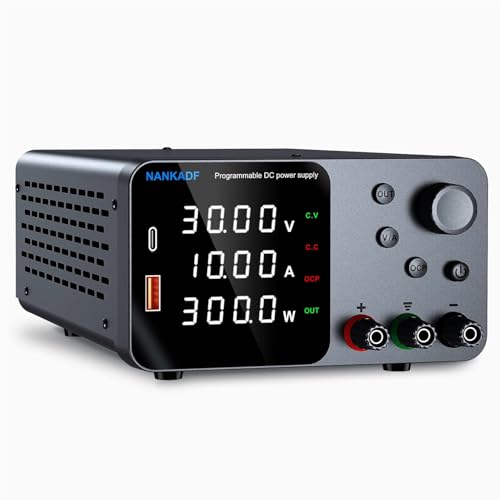
DC Power Supply 30V 10A with encoder control
NANKADF
Mid-RangeRoundups
- Best Lab Power Supplies for Charging Mobile Devices (2026)
- Best Lab Power Supplies for Lab Bench Experiments (2026)
- Best Lab Power Supplies for Powering Arduino Projects (2026)
- Best Lab Power Supplies for Electronics Prototyping (2026)
- Best Lab Power Supplies Under $200 (2026)
- Best Lab Power Supplies Under $100 (2026)
- Best Lab Power Supplies Under $50 (2026)
- Best Lab Power Supplies (2026 Guide)
Frequently Asked Questions
How do I choose the right lab power supply for my application?
Select a supply based on required maximum voltage and current, whether you need single or multiple outputs, and if you require constant voltage (CV) and constant current (CC) modes; also consider resolution, regulation accuracy, and protections like overcurrent and thermal shutdown
What are the differences between linear and switching lab power supplies?
Linear supplies provide very low noise and good transient response but are heavier and less efficient; switching supplies are lighter and more efficient with higher power density but can have higher output ripple and require filtering for sensitive circuits
What safety and protection features should I look for?
Look for adjustable overcurrent/overvoltage protection, short-circuit protection, thermal protection, clear status indicators, and isolation between outputs if using multiple channels to protect your device and the supply
How accurate and stable are typical benchtop lab power supplies?
Many lab supplies offer voltage and current regulation accuracy in the range of a few tenths to a few percent, with low ripple for bench-class units; check the datasheet for specific load/regulation and ripple/noise specifications for accuracy needs
What size or power rating should I pick for bench use vs. hobby projects?
For small electronics and hobby work, supplies rated 0–30 V at 1–5 A are usually sufficient; for heavier lab or industrial tasks, consider 30–60 V and 5–30 A or higher depending on load requirements
How do form factor and connectivity affect usability?
Benchtop units with front-panel knobs and clear displays are convenient for hands-on tuning, while compact or modular units save space; consider terminal types, banana/jack compatibility, remote sensing terminals, and computer interfaces (USB/LAN/GPIB) for automation
What maintenance and care do lab power supplies need?
Keep vents clear of dust, operate within rated temperature and load limits, periodically inspect output connectors and wiring, and follow the manufacturer’s calibration and service recommendations to ensure long-term accuracy and safety