Lab Stirrers
Lab Stirrers covers magnetic and overhead stirring devices used for mixing liquids in laboratory and industrial settings, with options from budget to mid-range. The category indexes 17 products averaging a 4.44 rating and roughly $34–$210 (average about (price varies)). Notable brands include LABHOUSE
Top Products

Rechargeable 3000rpm Magnetic Stirrer with Stir Bar
WEST TUNE
Mid-Range
Rechargeable Magnetic Stirrer 3000rpm with Stir Bar (WEST TUNE)
WEST TUNE
Budget
Taylor 9265 Magnetic Stirrer Starter Pack
Taylor Technologies
Mid-Range
PTFE Coated Propeller Stirrer, 65mm Ø, 8mm shaft, 350mm shaft length
ONiLAB
Budget
YaeCCC 1000ml Magnetic Stirrer Hot Plate
Yae First Trading Co.,Itd
Budget
VEVOR Magnetic Stirrer Hot Plate 0-1500 RPM 20L 650W
VEVOR
Mid-Range
78-1 Magnetic Stirrer Hot Plate 1000ml 2400 RPM
Feekoon
Budget
Magnetic stirrer hot plate with thermometer and retriever
BAITUSS
Mid-Range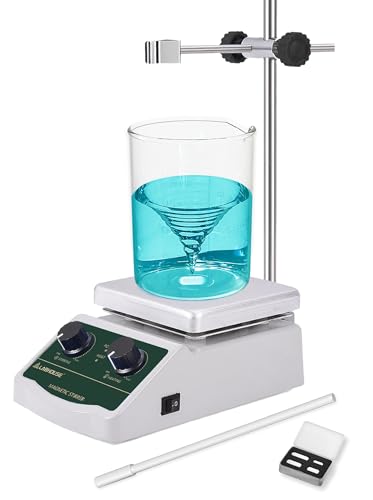
300C/572F Magnetic Stirrer Hot Plate 2L w/ Stand
LABHOUSE
Mid-Range
Labhouse 300C/572F Magnetic Stirrer Hot Plate 2L
LABHOUSE
Mid-Range
Slendor magnetic stirrer hot plate with 1000ml capacity
Slendor
Mid-Range
SH-3 Hot Plate Magnetic Stirrer, 5000ml, dual control
TOPLINE LAB
Premium
Slendor SH-2 magnetic stirrer hot plate mixer
Slendor
Mid-Range
Four E's Scientific 5 inch Digital Hotplate with Stirrer, 5 L, 0-1500 rpm
4E's Scientific
Premium
Magnetic stirrer hot plate 5 L, 0-1500 rpm, 600 W heating
FOUR E'S SCIENTIFIC
Premium
4 E's Scientific 5 inch Magnetic Stirrer Hot Plate
FOUR E'S SCIENTIFIC
Premium
Magnetic Stirrer Hot Plate 5L 300°C LCD 1600RPM
LACHOI
PremiumRoundups
Frequently Asked Questions
How do I choose the right lab stirrer for my application?
Select by intended use (magnetic stirrer for simple mixing, overhead stirrer for viscous or high-torque tasks), required stirring speed and torque, maximum vessel size, compatibility with chemical exposure, and whether digital controls or temperature features are needed
What's the difference between magnetic stirrers and overhead (mechanical) stirrers?
Magnetic stirrers use a rotating magnetic field and a stir bar inside the vessel, suited for low-viscosity liquids and sealed containers; overhead stirrers use a motor-driven shaft and impeller for higher-viscosity fluids, larger volumes, or when stronger mixing and precise torque are required
What safety and chemical-resistance features should I look for?
Look for splash-resistant or sealed housings, chemically resistant top plates (ceramic or stainless steel), secure mounting or clamps for overhead units, and grounded electrical designs; verify materials in contact with solvents are compatible to avoid corrosion or degradation
How much should I expect to pay and what affects price?
Lab stirrers typically range from budget models under $50 to more advanced units several hundred dollars; price is influenced by motor power/torque, digital controls, speed range, build quality, brand, and additional features like temperature control or programmable settings
What maintenance is required to keep a stirrer reliable?
Regularly clean the top plate and shaft per manufacturer guidance, inspect seals and stir bars for wear, lubricate or service moving parts on overhead units as recommended, and store in a dry, ventilated area to prevent corrosion and electrical issues
How do I match stir bar size and shape to my vessel and task?
Choose a stir bar length and thickness appropriate for the vessel diameter (small bars for narrow vessels, longer bars for large flasks) and pick shapes (octagonal, cross, or elliptical) that provide stable coupling at the target speeds; avoid oversized bars that contact vessel walls
Are digital controls and speed accuracy important for laboratory work?
Yes—digital controls and precise speed readouts are important when reproducibility matters, when following protocols that specify RPM, or when gradual speed ramps are required; analog units may be adequate for routine, non-sensitive mixing