Step Drill Bits
Step drill bits for metal and plastic create progressively larger holes with stepped cutting edges, available as single-piece or kit sets and in various diameters. The category includes 71 indexed products, average rating 4.48, price range about $32–$150, with brands like KLEIN TOOLS represented
Top Products

ZELCAN Step Drill Bit Set 5pc with Titanium-coated HSS bits
ZELCAN
Budget
TEMO M35 cobalt spiral flute step drill with 12 sizes
TEMO
Budget
TEMO 3pc M35 cobalt step drill set, 6/9/13 steps
TEMO
Budget
3 PCS Cobalt M35 Step Drill Bits Set 1/8" to 7/8"
IRONANT
Mid-Range
Irwin Unibit 3/4 to 1/4 in. Step-Drill Bit, 3/8 in. Shank (10233)
IRWIN
Budget
Step Drill Bits Set – 5 pcs, 50 sizes, HSS titanium coating
IRONANT
Budget
Step Drill Bit Set 1/4" to 1-3/8", HSS M2 straight grooved double fluted
Jerax tools
Budget
Klein Tools Step Drill Bit 3/8 in Hex Shank, #3 1/4-3/4 in
KLEIN TOOLS
Budget
Klein Tools KTSB14 Step Drill Bit 14, 3/16 to 7/8 in w/ hex shank
KLEIN TOOLS
Mid-Range
TEMO M35 cobalt step drill with two sizes (7/8" and 1-1/8")
TEMO
Mid-Range
Four Spiral Flute Cobalt Step Drill Bit, 1/4"-1-1/8", Hex Shank, 1/4"
AugTouf
Mid-Range
ZELCAN 19 sizes M35 cobalt step drill bit with tri-flat shank
ZELCAN
Budget
Four Spiral Flute M35 Step Drill Bit Set (9 Sizes) 3/8" Shank
BOYOUYS
Mid-Range
1/2, 7/8 & 1-3/8 in step drill bit set, straight grooved M2 HSS
Jerax tools
Mid-Range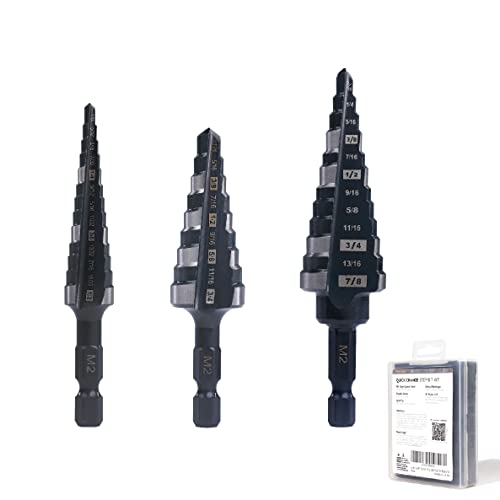
M2 HSS Quick Change Step Drill Bit Set (1/2", 3/4" & 7/8")
Jerax tools
Mid-Range
Klein Tools Step Drill Bit #11, 7/8 to 1-1/8 in, 3/8 in hex shank
KLEIN TOOLS
Mid-Range
KSEIBI 9-step 1/8-1 in SAE Step Drill Bit, HSS, black oxide, 1/4 in shank
KSEIBI
Budget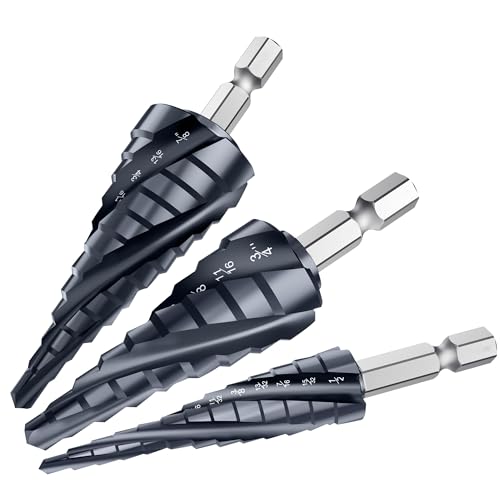
M35 Four-Flute Step Drill Bit Set (1/8"-7/8")
AIMLENTOOL
Budget
TEMO M35 cobalt double flute step drill, 10 sizes (13/16
TEMO
Mid-Range
M35 cobalt step drill bit set 12 step 3/16-7/8 in four-groove impact unibit
1WANYUE
Mid-Range
Klein Tools Step Drill Bit #15 7/8 to 1-3/8 in, hex shank
KLEIN TOOLS
Mid-Range
Four Spiral Flute M35 Step Drill Bit Set 1/4" - 1-1/8" (15 sizes), 3/8" shank
BOYOUYS
Mid-Range
Four Spiral Flute Cobalt Step Drill Bit, 7/8"–1-3/8" (19 steps)
AugTouf
Mid-Range
Irwin Unibit 13 1-1/8 in Step-Drill Bit, 1/2 in Shank
IRWIN
Mid-RangeRoundups
- Best Step Drill Bits for Metal Drilling (2026)
- Best Step Drill Bits for Stainless Steel Drilling (2026)
- Best Step Drill Bits for Drilling Stainless Steel (2026)
- Best Step Drill Bits Under $200 (2026)
- Best Step Drill Bits Under $100 (2026)
- Best Step Drill Bits Under $50 (2026)
- Best Step Drill Bits (2026 Guide)
Frequently Asked Questions
What is a step drill bit and what materials can it cut?
A step drill bit is a conical bit with multiple diameters (steps) that drills progressively larger holes; it's commonly used for sheet metal, thin plastics, laminates and some non-hardened, thin metals like aluminum and mild steel. It is not ideal for thick steel, masonry, or hardened metals
How do I choose the right size and type of step drill bit for my project?
Pick a bit whose step range covers the hole diameters you need and matches the material thickness; common options are single-bit cones, stepped multipoint bits, and sets that cover wider ranges. Also check shank type (hex or round) for drill chuck compatibility and look for coatings (TiN, TiAlN) or HSS/HSS-Co construction for better wear resistance on metal
Are step drill bits compatible with cordless drills and drill presses?
Yes — step drill bits can be used in cordless drills, right-angle drills, and drill presses as long as the drill provides adequate speed and stable clamping; for large-diameter steps or thicker materials, a drill press gives better control and cleaner holes
How should I use and maintain step drill bits to extend their life?
Use moderate drill speed and steady pressure, apply cutting lubricant when drilling metal, back the bit out periodically to clear chips, and store bits dry; sharpen or replace bits when edges dull to avoid excessive heat and poor hole quality
What performance differences should I expect between cheaper and higher-priced step drill sets?
Lower-cost bits are usually general-purpose HSS with minimal coating and may dull faster on metal, while higher-priced bits often use HSS-Co, better coatings, thicker bodies and more precise steps, resulting in longer life and cleaner holes in demanding applications
Do step drill bits create round holes or only enlargements of existing holes?
They can both create new round holes in thin materials and enlarge existing holes; because each step has a defined diameter, they produce circular holes corresponding to the step when used correctly on appropriate material thickness
How do I read the size markings and pick a step for the exact diameter I need?
Step drill bits typically have etched or printed diameter markings at each step; match the marking to the required finished hole size and stop drilling once the marked shoulder corresponding to that diameter reaches the work surface