Thickness Gauges
Thickness gauges in Tools & Industrial are handheld and digital instruments for measuring material thickness, coating depth, and film thickness across metals, plastics, and paint. The category lists 11 products averaging 4.44 stars, priced from $33 to $110 (average ~(price varies)), with brands like Neoteck among the top names
Top Products

Neoteck digital thickness gauge 0-1in 0.01mm LCD
Neoteck
Budget
Neoteck digital thickness gauge 0.5in/12.7mm
Neoteck
Mid-Range
Neoteck digital thickness gauge 0.5 inch 12.7 mm
Neoteck
Mid-Range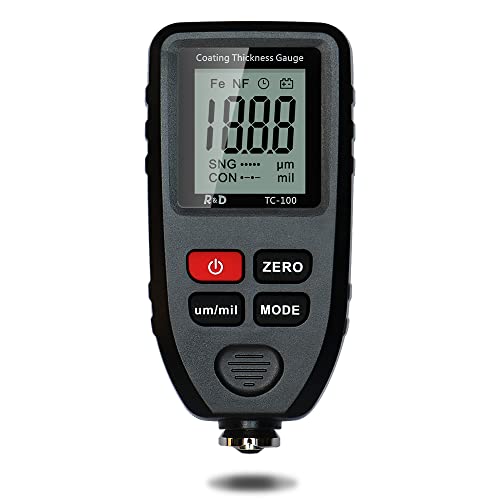
Car coating thickness meter for used car buyers
SHENZHEN REDDRAGON INSTRUMENTS CO.,LTD
Mid-Range
Neoteck Digital Thickness Gauge 0-1in, 0.00005in Resolution
Neoteck
Mid-Range
Neoteck digital thickness gauge 0-1 inch with lcd display
Neoteck
Mid-Range
Paint Thickness Gauge CM-205FN for Cars
VVV-Group
Mid-Range
KAIWEETS Paint Thickness Gauge for Car Coatings
KAIWEETS
Mid-Range
Paint Thickness Gauge CM-224Auto 2025
VVV-Group
Mid-Range
Digital Thickness Gauge 0.001mm/0.00005" with LCD
Mxmoonfree
Mid-Range
Digital coating thickness gauge CM-208FN for steel and aluminum
VVV-Group
PremiumRoundups
- Best Thickness Gauges for Measuring Paper Thickness (2026)
- Best Thickness Gauges for Measuring Leather Thickness (2026)
- Best Thickness Gauges for Quality Control In Workshops (2026)
- Best Thickness Gauges Under $200 (2026)
- Best Thickness Gauges Under $100 (2026)
- Best Thickness Gauges Under $50 (2026)
- Best Thickness Gauges (2026 Guide)
Frequently Asked Questions
How do I choose the right type of thickness gauge for my application?
Select based on material and measurement method: contact (mechanical or dial) gauges for sheet metal, plastics and thin materials; ultrasonic gauges for painted, coated, or layered materials and where non-contact measurement through coatings is needed. Also consider measurement range, resolution, and whether you need single- or dual-velocity ultrasonic modes for different substrates
What accuracy, resolution, and measurement range should I look for?
Look for resolution appropriate to the tolerance you need (common resolutions are 0.01 mm or 0.001 in), and accuracy typically specified as a ± value (for example ±0.02 mm). Choose a range that covers the thinnest and thickest parts you'll measure; ultrasonic gauges often cover 0.75 mm to several hundred millimeters, while mechanical gauges have lower ranges
Are digital or analog thickness gauges better for shop use?
Digital gauges provide faster readout, easier data logging and typically higher resolution; analog (dial) gauges can be rugged and simple to use. For routine inspection, digital models are often preferred; analog may suffice for basic, low-cost shop checks
What features affect durability and long-term reliability?
Key features are build quality (metal housings, sealed buttons), probe design (robust contact tips or protected ultrasonic transducers), battery type and battery life, and IP or dust/water resistance ratings. Calibration capability and availability of replacement probes or parts also influence long-term use
Do I need calibration and how often should a thickness gauge be calibrated?
Yes — gauges should be calibrated against certified standards. Frequency depends on use and requirements: common practice is annual calibration for general use and more frequent (quarterly or per-shift checks) in critical or high-use environments. Also perform a quick zero check before measurement sessions
Can thickness gauges measure through paint, coatings, or on curved surfaces?
Ultrasonic thickness gauges can measure through non-metallic coatings and paints if set to the correct probe delay and velocity; contact gauges cannot. Measurement on curved or small-diameter parts may require specialized small-diameter probes or acoustic coupling adjustments for accurate ultrasonic readings
What should I expect in price and what represents good value?
Entry-level mechanical or simple ultrasonic gauges often start under $50, while more capable digital and ultrasonic models with data logging and multi-mode capability commonly range higher. Good value matches the required accuracy, range and features (probe types, logging, durability) to your inspection needs rather than the